South Africa Travel Adapter
Embarking on a South African adventure requires the right power solution. Due to its unique Type M plug, a standard universal adapter often falls short, making a dedicated South Africa travel adapter essential for charging all your electronic devices. Ensure you pack this crucial item to stay connected and capture every moment of your journey.
Imagine this: you’ve just landed in beautiful South Africa, the sun is shining, and your camera is ready to capture the breathtaking landscapes and incredible wildlife. You pull out your phone to check your itinerary, but oh no – it’s running on fumes! No problem, you think, as you reach for your trusty universal travel adapter. You plug it into the wall, only to find it doesn’t fit. The pins are too small, or the configuration is all wrong. Panic sets in. How will you charge your phone, camera, or laptop?
This scenario is all too common for travelers heading to South Africa. Many assume a standard universal adapter will cover all bases, but South Africa has a unique electrical system that often catches visitors by surprise. To ensure a smooth, connected, and stress-free trip, understanding and acquiring the correct **South Africa travel adapter** is not just an accessory – it’s an absolute necessity. Let’s dive deep into everything you need to know to stay powered up on your South African adventure.
Key Takeaways
- Unique Plug Type M: South Africa uses a distinct three-round-pin plug, known as Type M, which is notably larger than common Type G (UK) or Type C (European) plugs.
- Universal Adapters May Fail: Many generic “universal” travel adapters on the market do not include the specific Type M configuration, rendering them useless in South Africa’s outlets.
- Voltage vs. Adapter: A travel adapter only changes the plug shape. Most modern electronics (like smartphones, laptops, and cameras) are dual voltage, meaning they automatically adapt to South Africa’s 230V system and won’t need a separate voltage converter.
- Essential Features: When purchasing a South Africa travel adapter, look for models that are grounded (with three pins), offer surge protection, and ideally include built-in USB charging ports for added convenience.
- Where to Buy: It’s highly recommended to purchase your South Africa travel adapter before you leave for your trip. This ensures you have it from day one and helps avoid potential last-minute stress or inflated prices at airports.
- Safety First: Always prioritize safety. Ensure your chosen adapter is certified (look for CE or RoHS marks) and used correctly to prevent any damage to your valuable devices or potential electrical hazards.
Quick Answers to Common Questions
What is the specific plug type used in South Africa?
South Africa uses the Type M plug, which features three large, round pins arranged in a triangular pattern.
Can I use my standard European or UK adapter in South Africa?
No, standard European (Type C, E, F) or UK (Type G) adapters will not fit into South African Type M outlets.
Do I need a voltage converter for my phone or laptop in South Africa?
Most modern phones, laptops, and camera chargers are dual voltage (100-240V) and will not require a voltage converter; only a South Africa travel adapter is needed.
What voltage and frequency does South Africa use?
South Africa uses a 230V supply voltage and 50Hz frequency.
Is it better to buy a South Africa travel adapter before my trip or in South Africa?
It is generally better to purchase your South Africa travel adapter before your trip to ensure you have it from the start and potentially save money.
📑 Table of Contents
The Unique South African Plug Type – Type M
South Africa stands out with its distinct electrical plug type, known as Type M. While many countries share common plug types, South Africa’s choice is less common globally, making it a crucial detail for any traveler to note.
What is Type M?
The Type M plug is easily recognizable by its three large, round pins. It features a central grounding pin that is thicker than the two power pins. Visually, it’s quite robust and larger than the more commonly seen Type C (two round pins, common in Europe) or Type G (three rectangular pins, common in the UK). The pins are arranged in a triangular pattern, ensuring a secure and stable connection. If you’ve never encountered it before, it looks quite substantial.
Voltage and Frequency in South Africa
Beyond the physical plug shape, it’s also important to understand the electrical current itself. South Africa operates on a 230V (Volts) supply voltage and 50Hz (Hertz) standard frequency.
* Voltage (230V): This refers to the “strength” of the electricity. For comparison, North America typically uses 110-120V, while most of Europe, Asia, and Oceania use 220-240V. South Africa aligns with the higher voltage standard.
* Frequency (50Hz): This refers to how often the alternating current changes direction. Again, North America uses 60Hz, while most other parts of the world, including South Africa, use 50Hz.
For most modern electronic devices like smartphones, laptops, tablets, and camera chargers, these voltage and frequency numbers are generally not a concern. We’ll explore why in a bit, but for now, remember that the primary challenge for travelers is the physical plug shape, making a dedicated **South Africa travel adapter** paramount.
Why a Universal Adapter Isn’t Always Enough for South Africa
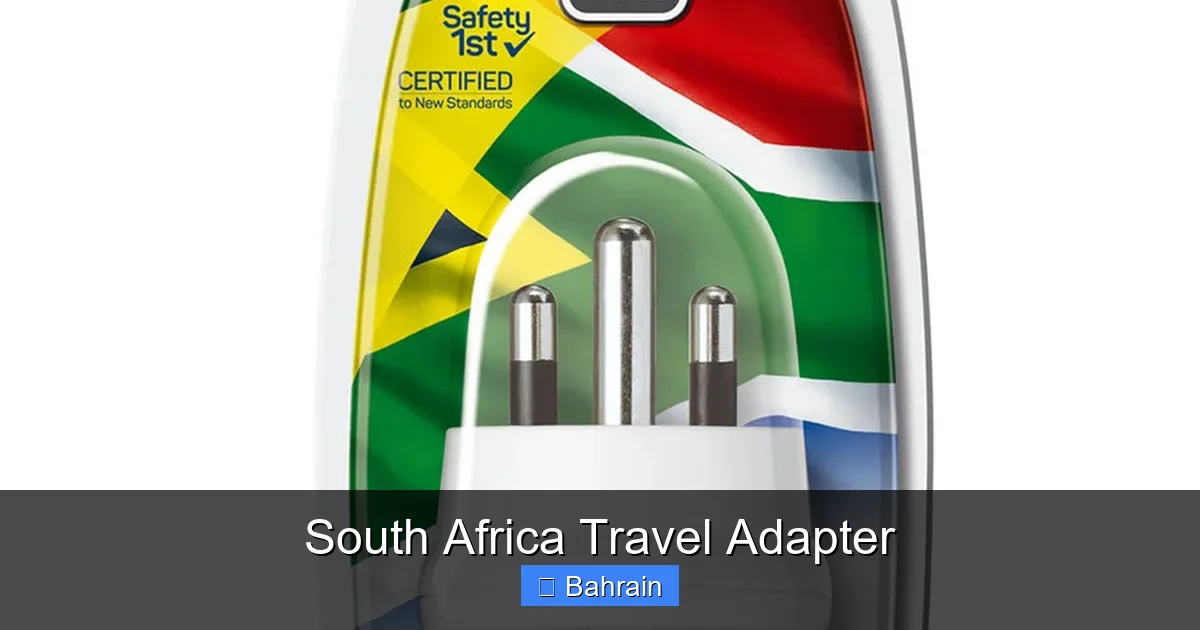
Visual guide about South Africa Travel Adapter
Image source: gapyeartravelstore.com
Many seasoned travelers proudly carry a “universal travel adapter” – those clever all-in-one devices that claim to fit outlets in over 150 countries. And for many destinations, they work perfectly! However, South Africa is one of those places where a standard universal adapter might let you down.
The “Universal” Misconception
The term “universal” can be a bit misleading. While many adapters cover the most common plug types like A/B (North America), C/E/F (Europe), G (UK), and I (Australia/China), they often omit the Type M plug. Why? Perhaps because Type M isn’t as widely used globally as the others, or its larger size makes it challenging to integrate into a compact “all-in-one” design without making the adapter excessively bulky.
So, you might arrive with a multi-adapter expecting to be prepared, only to find that the specific Type M pins are missing from its repertoire. This can be incredibly frustrating, especially after a long flight when you just want to charge your devices and settle in. It’s a common oversight that leads to many travelers scrambling for a solution upon arrival.
Don’t Get Caught Off Guard
Imagine having an incredible day exploring Table Mountain or spotting the Big Five, only to realize your phone’s battery is critically low, and your adapter doesn’t fit. No Instagram updates, no checking maps, no urgent calls – it’s a modern traveler’s nightmare! To avoid this kind of inconvenience and stress, investing in the correct **South Africa travel adapter** beforehand is a small effort with huge payoffs for your peace of mind.
Choosing the Right South Africa Travel Adapter
Now that you understand the necessity, let’s talk about how to choose the best **South Africa travel adapter** for your trip. Not all adapters are created equal, and some features can significantly enhance your travel experience.
Grounded vs. Ungrounded
The Type M plug, by design, includes a grounding pin. A grounded adapter (three pins) provides an extra layer of safety, protecting both you and your electronic devices from power surges or electrical faults. While you might find two-pin (ungrounded) adapters that fit the power pins, always opt for a three-pin, grounded **South Africa travel adapter** if your devices have a three-pin plug (like many laptop chargers). Most modern electronics that require grounding come with a three-pin plug for a reason.
Surge Protection
South Africa, like many regions, can experience occasional power fluctuations or surges. A travel adapter with built-in surge protection acts as a safeguard for your valuable electronics. It can absorb excess voltage, preventing it from reaching and potentially damaging your devices. This small feature can save you a lot of money and heartache. Always check for this if possible.
USB Ports for Convenience
In today’s world, most travelers carry multiple USB-chargeable devices: smartphones, smartwatches, power banks, headphones, etc. A **South Africa travel adapter** that also includes multiple USB-A and/or USB-C ports can be incredibly convenient. This allows you to charge your laptop via the main socket while simultaneously charging your phone and smartwatch directly from the adapter’s USB ports, minimizing the number of separate chargers and adapters you need to carry. It’s a fantastic space-saver and keeps things tidy.
Quality and Certification
Never compromise on quality when it comes to electrical accessories. Look for adapters from reputable brands and check for safety certifications such as CE (Conformité Européenne) or RoHS (Restriction of Hazardous Substances). These marks indicate that the product meets certain safety, health, and environmental protection standards. A cheap, uncertified adapter might be a false economy, posing risks to your devices or even personal safety.
Quantity Matters: How Many Adapters Do You Need?
Consider how many devices you’ll be traveling with and how many you need to charge simultaneously. If you’re traveling solo with just a phone and camera, one **South Africa travel adapter** might suffice. However, if you have a laptop, multiple phones, a tablet, and other gadgets, or if you’re traveling with companions, you might want to bring two or even three adapters. Alternatively, a single adapter paired with a small, multi-outlet power strip (we’ll discuss this soon) can be an efficient solution.
Voltage Converters vs. Travel Adapters: Do You Need Both?
This is a common point of confusion for many travelers. It’s vital to understand the difference between a travel adapter and a voltage converter. They serve entirely different purposes.
The Core Difference
* Travel Adapter: A **South Africa travel adapter** physically changes the shape of your plug so it can fit into a South African wall outlet. It does NOT change the voltage of the electricity.
* Voltage Converter: A voltage converter (or transformer) changes the electrical voltage from one level to another (e.g., from 230V to 110V, or vice versa).
Checking Your Devices: Dual Voltage is Your Friend
The good news is that for most modern electronic devices you’d bring on a trip – smartphones, laptops, tablets, camera chargers, e-readers, portable speakers – you likely won’t need a separate voltage converter.
How do you know? Look at the small print on your device’s power brick or charger. You’ll often see “INPUT: 100-240V, 50/60Hz”. This means your device is dual voltage or multi-voltage. It can safely handle any voltage between 100V and 240V, and any frequency between 50Hz and 60Hz. Since South Africa operates at 230V/50Hz, your dual-voltage devices will automatically adjust without needing a converter. You simply need the correct **South Africa travel adapter** to plug it in.
When a Converter IS Needed
A voltage converter is primarily necessary for older appliances or devices that are single voltage – meaning they are designed to operate only at a specific voltage, like 110V-120V (common in North America). This often includes high-heat appliances like hair dryers, curling irons, electric kettles, or older travel irons that are not dual voltage.
If you bring such a device to South Africa (230V) and plug it in without a converter, it will likely overheat, get damaged, or even create a fire hazard. Our strong recommendation? Leave these single-voltage, high-power appliances at home. Most accommodations in South Africa, especially hotels and guesthouses, provide hair dryers, or you can purchase inexpensive dual-voltage travel versions if absolutely necessary. For everything else that’s modern and low-power, just a **South Africa travel adapter** will do the trick!
Practical Tips for Powering Your Devices in South Africa
Beyond just buying the right adapter, there are a few clever tricks and safety considerations that can make powering your devices in South Africa even smoother.
The Power Strip Trick
This is a favorite among savvy travelers! If you only want to buy one **South Africa travel adapter**, but you have many devices to charge, bring a small, multi-outlet power strip from your home country. You plug your single South Africa travel adapter into the wall, and then plug your domestic power strip into the adapter. Now you have multiple outlets (of your home country’s type) for all your devices. Just make sure your power strip is suitable for the voltage (most are just extension cords and don’t convert voltage, so this only works for dual-voltage devices). This strategy is fantastic for families or anyone with a gadget-heavy travel style.
Battery Packs and Car Chargers
Always carry a fully charged portable power bank. These are lifesavers for charging phones and other small devices on the go, especially during long safari drives or day trips where wall outlets aren’t available. If you’re renting a car, a USB car charger is another excellent backup for keeping your devices topped up while driving between destinations. This ensures you’re never caught with a dead battery, even if your **South Africa travel adapter** is back in your accommodation.
Where to Buy Your Adapter
* Before You Leave (Recommended): The best place to buy your **South Africa travel adapter** is before you even depart. You can find them at electronics stores, airport shops (though often overpriced), or online retailers. Buying it in advance ensures you have it packed and ready from day one of your trip.
* Upon Arrival in South Africa: If you forget, don’t panic. You can usually find Type M adapters at larger supermarkets (like Pick n Pay or Shoprite), electronics stores (such as Incredible Connection), or even some convenience stores and guesthouses. However, selection might be limited, and prices could be higher than what you’d pay at home.
Safety Considerations
* Don’t Overload: While a power strip is handy, be mindful not to overload the circuit. Avoid plugging in too many high-power devices simultaneously, especially if they are single-voltage (which you ideally shouldn’t be bringing anyway).
* Water and Electrical Outlets: Always keep electrical devices and adapters away from water, especially in bathrooms.
* Unplug When Not in Use: It’s good practice to unplug adapters and chargers when not in use, especially overnight or when leaving your accommodation.
By following these practical tips, you can ensure a seamless and safe experience keeping all your essential devices powered throughout your incredible journey through South Africa.
Conclusion
A trip to South Africa promises unforgettable memories, from the vibrant culture of Cape Town to the unparalleled wildlife of the Kruger National Park. The last thing you want is to miss out on capturing those moments or staying connected with loved ones because of a dead battery. The unique Type M plug design means that a dedicated **South Africa travel adapter** is an absolute must-have in your packing list.
By understanding the local electrical system, choosing a high-quality, grounded adapter with surge protection, and being mindful of voltage requirements, you can navigate the power landscape with confidence. Don’t let a small detail derail your grand adventure. Pack smart, stay charged, and fully immerse yourself in the magic that South Africa has to offer. Happy travels!
Frequently Asked Questions
Will my universal travel adapter work in South Africa?
Many common “universal” travel adapters do not include the specific Type M plug configuration used in South Africa. It’s crucial to verify if your universal adapter explicitly supports Type M outlets before your trip.
What should I look for when buying a South Africa travel adapter?
When buying a South Africa travel adapter, look for a grounded (three-pin) model with surge protection for device safety, and consider one with built-in USB ports for added charging convenience.
Can I charge multiple devices with one South Africa travel adapter?
Yes, you can charge multiple devices by using a single South Africa travel adapter in conjunction with a small, multi-outlet power strip from your home country. Alternatively, some adapters come with multiple USB charging ports.
Are power outlets in South Africa safe?
Power outlets in South Africa are generally safe, but ensuring your South Africa travel adapter is of good quality, grounded, and used correctly adds an important layer of protection against electrical issues.
What if I forget my South Africa travel adapter?
If you forget your adapter, you can often find them in larger supermarkets, electronics stores (like Incredible Connection), or even at some guesthouses in South Africa, although prices might be higher.
Is the South Africa travel adapter useful anywhere else?
Yes, the Type M plug, while specific, is also used in a few other countries. These include Lesotho, Mozambique, Namibia, Eswatini (Swaziland), and parts of India, making it a potentially useful adapter for other regional travels.