Battery for a Travel Trailer
Choosing the right battery for a travel trailer is crucial for powering your adventures and ensuring comfort on the road. This guide covers everything from understanding different battery types like lead-acid and lithium, to properly sizing your battery bank, and essential maintenance tips. With the right power source, you’ll enjoy extended boondocking and worry-free travels, making your travel trailer a true home away from home.
Hey there, fellow adventurer! Are you dreaming of wide-open roads, scenic campsites, and the freedom to explore wherever your heart desires in your travel trailer? One of the most critical, yet often overlooked, components that make those dreams a reality is your travel trailer’s battery. It’s not just a box that sits there; it’s the heart of your mobile power system, responsible for keeping your lights on, your fridge cold, and your devices charged, especially when you’re off-grid.
Understanding the right battery for a travel trailer might seem a bit daunting at first. With so many types, sizes, and charging methods out there, it’s easy to get overwhelmed. But don’t worry, we’re here to demystify it all for you. Think of this as your friendly guide to choosing, maintaining, and maximizing the performance of your travel trailer battery, ensuring you have reliable power for every mile of your journey.
In this comprehensive guide, we’ll dive deep into everything you need to know about powering your RV life. From the different battery chemistries available and how to figure out what size battery bank you really need, to smart charging techniques and essential maintenance tips that will extend your battery’s life, we’ve got you covered. Get ready to power up your travels with confidence and enjoy every moment in your beloved travel trailer!
Key Takeaways
- Battery Type Matters: Lead-acid (flooded, AGM, gel) and lithium (LiFePO4) batteries each have distinct pros and cons regarding cost, weight, lifespan, and performance. Lithium is often superior for serious RVers but comes at a higher initial price.
- Sizing is Crucial: Accurately calculate your daily power consumption in amp-hours (Ah) to determine the right battery bank size for your travel trailer, ensuring you have enough usable capacity for your needs, especially if you plan to boondock.
- Effective Charging is Key: Utilize a multi-faceted charging approach, including shore power, solar panels, DC-DC chargers, and generators, to keep your travel trailer battery topped up and extend its overall life.
- Maintenance Extends Life: Regular maintenance, like checking water levels in flooded batteries, keeping terminals clean, avoiding deep discharges, and proper storage during off-season, significantly prolongs the lifespan of your battery.
- Safety First: Ensure your battery for a travel trailer is installed securely, properly ventilated, and protected with appropriate fusing and wiring to prevent hazards and ensure safe operation.
- Invest in Monitoring: A good battery monitor provides real-time data on your battery’s state of charge, helping you manage power consumption and avoid damaging deep discharges.
Quick Answers to Common Questions
What type of battery is best for a travel trailer?
Lithium Iron Phosphate (LiFePO4) batteries are generally considered the best due to their lighter weight, longer lifespan, higher usable capacity, and faster charging, though they have a higher upfront cost. AGM lead-acid batteries are a good compromise for budget and performance.
How do I know what size battery I need for my travel trailer?
You determine the size by calculating your daily power consumption in amp-hours (Ah) by listing all your appliances and their estimated daily usage. Then, consider the number of days you want to go without charging and the usable capacity of your chosen battery type (50% for lead-acid, 80-100% for lithium).
Can I use a car battery in my travel trailer?
No, car batteries (starting batteries) are designed to provide a short burst of high current for starting an engine, not for deep, sustained discharges needed for a travel trailer. You need a “deep cycle” battery for your RV’s house power.
How often should I charge my travel trailer battery?
Ideally, you should keep your battery for a travel trailer as close to a full charge as possible, especially lead-acid batteries. If boondocking, recharge when your lead-acid battery reaches 50% state of charge or your lithium battery reaches 20%.
Is solar power enough to charge my travel trailer battery?
Solar power can be a primary charging source, but whether it’s “enough” depends on your daily power consumption, the size of your solar array, and the amount of sunlight you receive. For heavy users or cloudy conditions, supplemental charging from a generator or DC-DC charger may be necessary.
📑 Table of Contents
Why a Good Battery is Essential for Your Travel Trailer Adventures
A robust and reliable battery for a travel trailer isn’t just a luxury; it’s an absolute necessity for enjoying the full potential of your RV. Without adequate power, your “home on wheels” can quickly feel less like a cozy retreat and more like a basic tent. Let’s explore why investing in the right battery system is so crucial.
Powering Your Essentials
Imagine pulling into a beautiful, remote campsite, ready to relax after a long drive. You turn on the lights, open the fridge for a cold drink, and maybe even watch a movie on your tablet. All these simple comforts rely entirely on your travel trailer battery. It powers everything from your water pump for a refreshing shower to the furnace on a chilly night, and even keeps your safety devices like smoke detectors operational. Without sufficient battery power, these essentials become unavailable, diminishing your camping experience.
Freedom to Boondock
One of the biggest advantages of a travel trailer is the ability to explore beyond developed campgrounds. This is often called “boondocking” or “dry camping.” When you’re off-grid, there are no electrical hookups, which means your battery for a travel trailer is your *only* source of power. A well-sized and maintained battery bank allows you to extend your stays in remote, picturesque locations, truly embracing the freedom that RVing offers. It means you can stay out longer, enjoy nature more, and avoid the crowded fee-based campgrounds.
Safety and Convenience
Beyond comfort, your travel trailer battery also plays a significant role in safety and convenience. It powers essential safety systems like carbon monoxide detectors and propane leak alarms. In an emergency, it can keep your communication devices charged. Furthermore, a reliable battery ensures that you can operate your awning, slide-outs, and even your leveling jacks, making setup and breakdown a breeze rather than a manual chore. A healthy battery system offers peace of mind, letting you focus on making memories rather than worrying about power.
Understanding Travel Trailer Battery Types
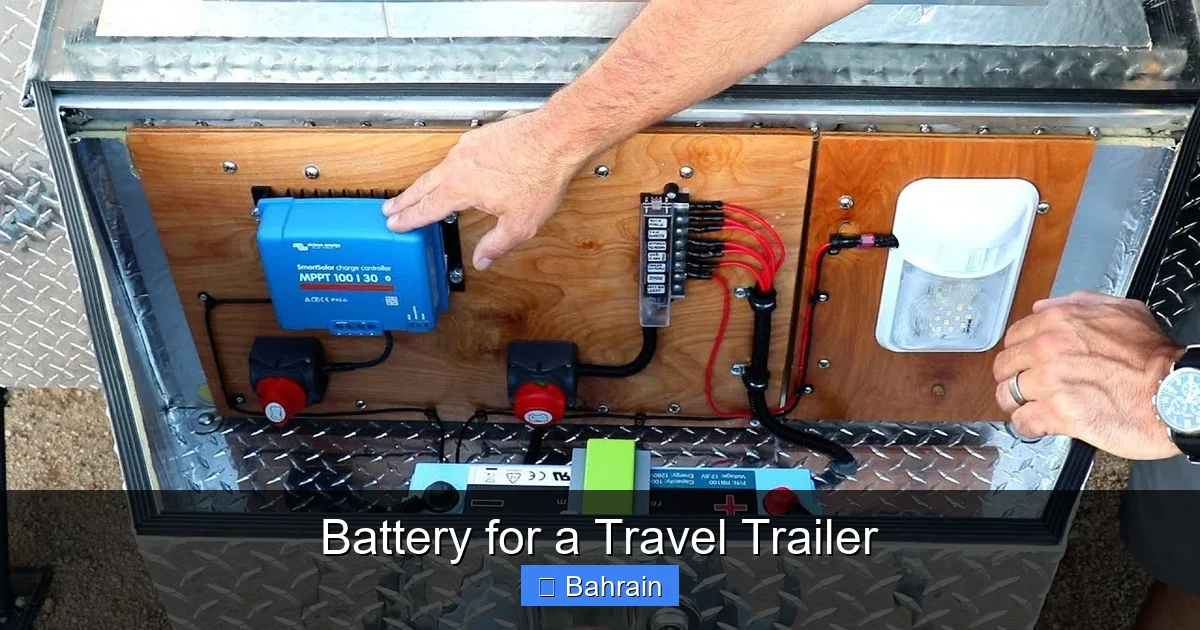
Visual guide about Battery for a Travel Trailer
Image source: i.ytimg.com
When it comes to the battery for a travel trailer, you’ll encounter a few main types, each with its own set of characteristics, advantages, and disadvantages. Knowing these differences will help you make an informed decision based on your camping style, budget, and power needs.
Lead-Acid Batteries (Flooded, AGM, Gel)
Lead-acid batteries are the traditional workhorses in the RV world. They’ve been around forever and are generally the most affordable option upfront.
* **Flooded Lead-Acid (FLA):** These are the most common and least expensive. They require regular maintenance, specifically checking and topping off water levels with distilled water. They can handle deep discharges better than starting batteries but usually shouldn’t be discharged below 50% capacity to maximize their lifespan. They also vent gases, so proper ventilation is crucial.
* **Absorbed Glass Mat (AGM):** AGM batteries are a step up. They’re sealed, maintenance-free, and can be mounted in more positions without spilling. They handle vibration well, charge faster than FLAs, and have a lower self-discharge rate. While they tolerate deeper discharges better than FLAs, sticking to the 50% rule is still best for longevity. They are more expensive than FLAs but offer greater convenience and durability.
* **Gel Batteries:** Gel batteries are similar to AGMs in being sealed and maintenance-free. They use a silica gel to suspend the electrolyte. They are very good at deep discharges and have excellent cycle life, but they charge much slower and can be sensitive to overcharging. They are generally more expensive than AGMs and less common in RVs due to their specific charging requirements and lower power output compared to AGM for a given size.
Lithium-Ion (LiFePO4) Batteries
Lithium Iron Phosphate (LiFePO4 or LFP) batteries are rapidly becoming the gold standard for RVers, especially those who boondock frequently.
* **Higher Usable Capacity:** The biggest advantage is their usable capacity. You can safely discharge LiFePO4 batteries down to 80-100% without damaging them, effectively giving you twice the usable power compared to a similarly rated lead-acid battery (which should only be discharged to 50%). So, a 100 Ah lithium battery can provide roughly the same usable energy as a 200 Ah lead-acid battery.
* **Lighter Weight:** They are significantly lighter than lead-acid batteries, which is a huge plus for travel trailers where weight is always a concern.
* **Longer Lifespan:** LiFePO4 batteries last much longer, often 10-15 years or 3,000-5,000 charge cycles, compared to 2-5 years or 300-1,000 cycles for lead-acid. This means less frequent replacements.
* **Faster Charging:** They accept a charge much faster, getting you back to full power quickly.
* **Consistent Power Output:** Lithium batteries maintain a more consistent voltage throughout their discharge cycle, meaning your appliances get a steady power supply until the battery is nearly depleted.
* **Higher Initial Cost:** The main drawback is the higher upfront cost. However, considering their longevity, usable capacity, and performance, they often prove to be more cost-effective in the long run.
Choosing the Right Type for Your Needs
Your choice of battery for a travel trailer depends on several factors:
* **Budget:** Lead-acid is cheapest upfront; lithium is a higher investment but offers long-term savings.
* **Camping Style:** If you primarily stay at campgrounds with shore power, lead-acid might suffice. For frequent boondocking, lithium is a game-changer.
* **Weight Constraints:** Lithium is significantly lighter.
* **Maintenance Preference:** Sealed lead-acid (AGM/Gel) and lithium are maintenance-free. Flooded lead-acid requires regular checks.
Sizing Your Battery Bank: How Much Power Do You Need?
Picking the right size battery for a travel trailer is one of the most critical steps. Too small, and you’ll constantly be running out of power. Too large, and you’ve overspent and added unnecessary weight. It’s all about balancing your power needs with your battery capacity.
Calculating Your Daily Power Consumption (Amp-Hours)
This is the cornerstone of battery sizing. You need to list every electrical appliance you plan to use in your travel trailer and estimate how long you’ll use it per day.
1. **List Appliances:** Lights, water pump, fridge (if 12V DC), furnace fan, phone chargers, laptop, TV, inverter for AC appliances, etc.
2. **Find Amperage/Wattage:** Look at the labels on your appliances. Most 12V DC items will list amps directly. For AC items or items listed in watts, convert to amps:
* *Watts / Volts = Amps* (For 12V DC systems, use 12V. For 120V AC systems, you’ll need an inverter, so calculate the DC amps the inverter will draw).
* Example: A 20W LED light on a 12V system draws 20W / 12V = 1.67 Amps.
3. **Estimate Daily Usage:** How many hours per day will you run each item?
4. **Calculate Daily Amp-Hours (Ah):** Multiply each item’s amperage by its daily usage time.
* Example: 1.67 Amps (LED light) x 5 hours = 8.35 Ah.
5. **Sum It Up:** Add all the daily amp-hours together. This is your total daily power consumption.
* *Pro Tip:* Add a 15-20% buffer for unexpected usage or efficiency losses.
Let’s say your total daily consumption is 80 Ah.
Considering Discharge Depth and Usable Capacity
Now, here’s where battery type really matters:
* **Lead-Acid Batteries:** To maximize their lifespan, you should generally only discharge them to 50% of their rated capacity. So, if your daily consumption is 80 Ah, you’d need a lead-acid battery bank with at least 160 Ah *rated capacity* (80 Ah usable). For a multi-day trip, you’d multiply that by the number of days you want to go without charging. For 3 days, you’d need 3 x 80 Ah = 240 Ah usable, meaning a 480 Ah rated lead-acid bank.
* **Lithium (LiFePO4) Batteries:** You can safely discharge these to 80-100%. So, for 80 Ah daily consumption, you’d need a lithium battery with approximately 80-100 Ah rated capacity. For a 3-day trip, you’d need 3 x 80 Ah = 240 Ah rated lithium battery bank.
As you can see, a 240 Ah lithium bank provides the same multi-day usable power as a 480 Ah lead-acid bank, but at a fraction of the weight and often in a smaller footprint.
Factors Affecting Battery Size
* **Boondocking Duration:** How many days do you want to go without charging?
* **Appliance Use:** Do you plan on using high-draw appliances like microwaves, coffee makers, or hair dryers (which require an inverter and draw significant power)?
* **Charging Sources:** Do you have solar panels? How much capacity do they add? This can offset your battery needs.
* **Climate:** Cold weather reduces battery performance, especially lead-acid, and increases furnace usage.
Charging Your Travel Trailer Battery Effectively
Having a great battery for a travel trailer is only half the battle; keeping it charged is the other! A multi-pronged approach to charging ensures you always have power, no matter where your adventures take you.
Shore Power Charging
This is the most straightforward method. When you plug your travel trailer into an RV park’s electrical pedestal or a household outlet (with an adapter), your RV’s built-in converter/charger automatically charges your house battery. Make sure your converter is compatible with your battery type, especially if you upgrade to lithium, as lithium batteries require specific charging profiles.
Solar Power Systems
Solar panels are a fantastic way to keep your battery for a travel trailer topped up, particularly for boondockers.
* **Components:** A solar system typically includes solar panels, a charge controller (MPPT controllers are more efficient than PWM), and wiring.
* **Benefits:** Silent, renewable, and allows for extended off-grid stays.
* **Sizing:** The number of panels and their wattage should be matched to your daily power consumption and the amount of sunlight you expect. For instance, if you consume 80 Ah daily, and your solar system can produce 40 Ah, you’ll still need other charging methods or reduce consumption.
DC-DC Chargers (Alternator Charging)
If your tow vehicle is running, a DC-DC charger can efficiently charge your travel trailer battery from your vehicle’s alternator. Standard 7-pin connectors often only provide a trickle charge, which isn’t enough for significant charging, especially for large battery banks or lithium batteries. A dedicated DC-DC charger ensures optimal charging voltage and current, preventing damage to both your vehicle’s alternator and your RV battery.
Generators
A portable generator is a reliable backup charging source, especially on cloudy days or when you need to run high-draw appliances for short periods. They quickly replenish your battery bank. Ensure you have a quiet generator for campground etiquette and proper ventilation when running it.
Smart Chargers and Battery Monitors
* **Smart Chargers:** Invest in a multi-stage smart charger that adjusts its charging output based on your battery’s state of charge and type. This prevents overcharging and prolongs battery life.
* **Battery Monitors:** A good battery monitor (like a Victron BMV or similar) is invaluable. It gives you real-time data on your battery’s voltage, current (amps in/out), and most importantly, your state of charge (remaining usable capacity in Ah or percentage). This helps you manage your power consumption and avoid damaging deep discharges.
Maintenance Tips to Extend Your Battery’s Life
Your battery for a travel trailer is an investment, and proper maintenance can significantly extend its lifespan, saving you money and hassle in the long run.
Regular Inspections
* **Flooded Lead-Acid:** Check the water levels every month or two, especially during heavy use. Top up with distilled water if the plates are exposed.
* **All Batteries:** Visually inspect battery terminals for corrosion, loose connections, or physical damage. Make sure the battery case is clean and free of cracks.
Proper Storage
When storing your travel trailer for the off-season:
* **Fully Charge:** Fully charge your battery before storage.
* **Disconnect:** Disconnect the battery from the travel trailer to prevent parasitic drains (small electrical draws that can slowly drain your battery even when everything is off).
* **Maintain Charge:** If storing for extended periods, especially in cold weather, consider using a smart trickle charger or battery maintainer that’s specifically designed for your battery type. Flooded lead-acid batteries can freeze if left discharged in cold temperatures, causing irreparable damage. Lithium batteries have specific low-temperature charging limits.
Avoiding Deep Discharges
This is critical for lead-acid batteries. Never discharge them below 50% capacity if you want them to last. While lithium batteries can handle deeper discharges, consistently running any battery down to near zero can still reduce its overall cycle life. Monitor your battery’s state of charge closely.
Cleaning Terminals
Corrosion on battery terminals (the fuzzy blue or white stuff) impedes current flow and reduces charging efficiency. Clean terminals regularly with a wire brush and a baking soda and water solution. Rinse thoroughly and apply a thin layer of dielectric grease or an anti-corrosion spray.
Installation and Safety Considerations
Installing and using your battery for a travel trailer safely is paramount. Incorrect installation can lead to inefficient operation, battery damage, or even dangerous situations.
Proper Ventilation
Flooded lead-acid batteries release hydrogen gas during charging, which is flammable and can build up in enclosed spaces. Ensure your battery compartment is well-ventilated, either through vents or an open top. AGM and lithium batteries are sealed and do not off-gas significantly, offering more flexibility in mounting locations.
Secure Mounting
Batteries are heavy, especially lead-acid ones. Ensure your battery for a travel trailer is securely mounted in a proper battery box or tray to prevent it from shifting, tipping, or being damaged during travel. Loose batteries can be a hazard.
Fusing and Wiring
* **Fuses/Circuit Breakers:** Always use appropriately sized fuses or circuit breakers as close to the battery as possible on the positive cable. This protects your wiring and appliances from short circuits and overloads.
* **Wire Gauge:** Use the correct wire gauge for the length of the run and the current draw. Undersized wires can overheat and cause a fire risk, while oversized wires are unnecessary weight and cost. Consult a wire gauge chart or an RV electrician if unsure.
* **Polarity:** Double-check polarity when connecting your battery (positive to positive, negative to negative). Reversing polarity can severely damage your RV’s electrical system and appliances.
Handling and Disposal
* **Lifting:** Batteries are heavy. Use proper lifting techniques or get help to avoid injury.
* **Disposal:** Never throw away old batteries in regular trash. Lead-acid and lithium batteries contain hazardous materials and must be recycled properly. Most auto parts stores and battery retailers offer recycling programs.
Conclusion
Choosing and maintaining the right battery for a travel trailer is fundamental to a successful and enjoyable RV experience. By understanding the different types of batteries, carefully calculating your power needs, implementing smart charging strategies, and performing routine maintenance, you can ensure your travel trailer is always ready for your next adventure. Whether you’re a weekend warrior or a full-time boondocker, investing time in your battery system will pay dividends in comfort, freedom, and peace of mind on the open road. So go ahead, power up those dreams, and hit the highway with confidence, knowing your travel trailer battery has got your back!
Frequently Asked Questions
What is the difference between a 12V and 6V battery for a travel trailer?
Most travel trailer systems are 12V. While 12V deep-cycle batteries are common, some RVers use two 6V “golf cart” batteries wired in series to create a 12V bank. Two 6V batteries often offer more amp-hours and better deep-cycle performance than a single 12V battery of similar size.
How do I prevent my travel trailer battery from freezing?
To prevent freezing, especially with lead-acid batteries, ensure they are fully charged before storing them in cold weather. A discharged lead-acid battery’s electrolyte is mostly water and can freeze, causing permanent damage. Lithium batteries often have a built-in Battery Management System (BMS) that prevents charging below freezing temperatures, but should still be stored with a good charge in a moderate environment if possible.
Can I mix different types of batteries in my travel trailer?
It is generally not recommended to mix different battery chemistries (e.g., lead-acid and lithium) or even different capacities/ages of the same type. This can lead to inefficient charging, reduced performance, and premature failure of one or more batteries, as they have different charging requirements and discharge curves.
What is a battery monitor and why do I need one for my travel trailer?
A battery monitor is a device that provides accurate, real-time information about your battery’s state of charge, voltage, current in/out, and power consumption. You need one because your RV’s built-in voltage meter is often inaccurate for judging actual capacity, and a monitor helps you avoid damaging deep discharges and effectively manage your power.
How long does a travel trailer battery typically last?
The lifespan of a travel trailer battery varies significantly by type and how well it’s maintained. Flooded lead-acid batteries typically last 2-5 years, AGM batteries 4-7 years, and lithium (LiFePO4) batteries can last 10-15 years or even longer, often achieving 3,000-5,000 charge cycles.
Do I need an inverter for my travel trailer battery?
You need an inverter if you want to power standard household 120V AC appliances (like a coffee maker, microwave, or hair dryer) from your 12V DC travel trailer battery bank. If you only use 12V DC appliances, an inverter is not necessary.